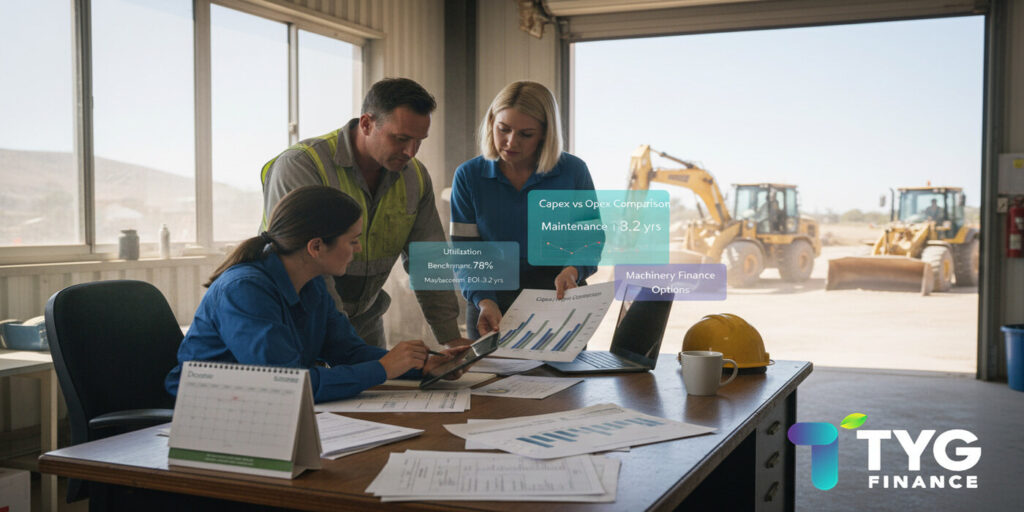
Why Year-End Decisions Carry Extra Weight
For asset-backed businesses in transport, mining, agriculture, and construction, the close of the financial year often sparks a deeper look at machinery strategies. Operators review utilisation benchmarks, weigh upcoming project requirements, and consider whether fresh investment could deliver better returns than stretching existing assets.
The challenge lies in striking a balance: upgrading too early can tie up capital, while delaying too long can lead to higher maintenance costs and reduced productivity. Financing solutions offer potential pathways, but the right choice depends on how utilisation and cost structures align with operational priorities.
This article shares insights on how operators often frame year-end machinery decisions, focusing on utilisation benchmarks, financing models, and industry perspectives. For operators weighing whether to buy, hire or lease at year‑end, our guide to year‑end machinery investment decisions walks through those options in more detail.
Insight 1: Utilisation Benchmarks Are a Key Decision Trigger
One of the most common factors shaping machinery investment is utilisation. How often and how intensively machinery is used often determines whether it makes sense to own, lease, or hire.
Typical considerations include:
- High utilisation: Daily or near-daily use may support ownership through purchase or long-term financing.
- Moderate utilisation: Seasonal or cyclical projects may align with leasing arrangements.
- Low utilisation: Occasional projects may justify hiring instead of locking in long-term costs.
Industry bodies such as the Civil Contractors Federation highlight that utilisation analysis helps avoid idle assets, which can drain both cash flow and workshop resources.
Operators looking at ownership pathways often explore tailored Machinery Finance solutions to spread costs predictably. For a deeper look at how utilisation, duty cycles and lifecycle costs inform replacement timing, see our key insights on fleet replacement planning.
Insight 2: Capex vs Opex Considerations Shape Strategy
Whether machinery expenses are treated as capital expenditure (capex) or operating expenditure (opex) can significantly influence decisions.
- Capex (buying or financing): Builds asset value, provides long-term control, and can strengthen fleet consistency.
- Opex (leasing or hiring): Offers flexibility, reduces upfront capital demands, and keeps balance sheets lighter.
Financial analytics services often note that businesses balancing capex and opex strategically may achieve stronger resilience – retaining capital for unexpected challenges while still upgrading critical assets when needed.
Broader Equipment Finance options may give operators flexibility to align spending with cash flow. Agricultural operators can see how utilisation and seasonality play out in practice in our guide to financing farm machinery for harvest.
Insight 3: Maintenance Costs Are the Silent Factor
Machinery that is past its prime can erode productivity even if utilisation levels appear sustainable. Maintenance costs – often underestimated – can rise sharply after certain usage thresholds.
Key questions operators may ask include:
- At what point do annual repairs exceed the cost of financing a newer machine?
- Could downtime risk outweigh the savings of holding off on replacement?
- Would newer machinery reduce compliance risks and insurance premiums?
When seen through this lens, financing a replacement may appear less about expense and more about managing operational risk.
Insight 4: Financing Models Provide Different Levers
Operators evaluating year-end options often explore a mix of financing models, each offering unique advantages.
| Financing Model | Possible Benefits | Considerations |
|---|---|---|
| Chattel Mortgage | Ownership from day one; flexible terms | Requires upfront GST and capital planning |
| Finance Lease | Lower upfront outlay; predictable repayments | No ownership at lease end unless bought |
| Operating Lease | Treated as opex; equipment upgraded easily | Higher long-term cost; usage restrictions |
| Hire Purchase | Spreads cost; ownership transfers on completion | Can feel less flexible mid-term |
Selecting the right model depends on how the business wants to balance liquidity, asset control, and accounting treatment. Our case study on financing $5M in machinery shows how these structures can be combined to preserve liquidity while still securing critical assets.
Insight 5: Timing and Commissioning Matter
Even when financing is secured, operators often face practical challenges around delivery and commissioning. Lead times for new machinery, workforce training, and compliance checks can stretch well past year-end.
Proactive operators may:
- Seek pre-approvals to move quickly when machinery is available.
- Align commissioning during seasonal downtimes to avoid lost productivity.
- Plan financing schedules that anticipate commissioning delays.
This forward planning can smooth the transition from decision to operation.
Practical Takeaways
- Analyse utilisation data to determine if machinery is under- or over-used.
- Balance capex and opex to preserve cash flow flexibility.
- Factor in maintenance curves when comparing old vs new machinery.
- Select financing models that align with long-term goals.
- Plan commissioning early to avoid disruptions when machinery arrives.
Framing Smarter Year-End Machinery Decisions
Year-end machinery planning is not about rushing into purchases – it is about weighing utilisation benchmarks, understanding cash flow implications, and aligning financing with operational strategy.
For asset-backed businesses, financing can be more than just a payment tool. With the right structure, it may serve as a lever for managing risk, preserving capital, and ensuring machinery supports both compliance and productivity in the year ahead.
Get Pre-Approved Today with TYG Finance and explore financing solutions tailored to your machinery utilisation needs.