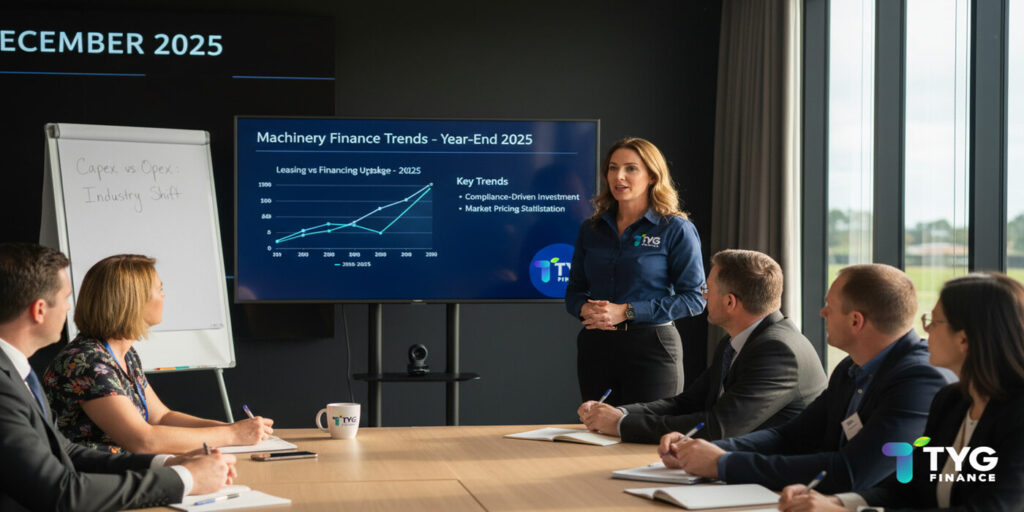
Why Year-End Financing Decisions Matter
As 2025 draws to a close, many operators in transport, mining, agriculture, and construction are reviewing their machinery and equipment strategies. For asset-backed businesses, the question is not only what machinery is needed, but also how it will be financed.
Market conditions, evolving finance options, and leasing versus purchasing dynamics are all shaping how businesses approach year-end investments. Operators who monitor these trends may find themselves better positioned to maximise uptime, preserve cash flow, and maintain compliance going into 2026.
This article explores the financing trends that could influence decision-making at year-end. For a practical framework on weighing buy, hire and lease decisions alongside utilisation and commissioning timelines, see our guide to year‑end machinery investment decisions.
Trend 1: Leasing Gains Traction Against Purchasing
While outright ownership remains important, leasing is increasingly becoming a strategic choice, especially for machinery with high maintenance costs or shorter lifespans.
Operators often view leasing as:
- A way to access newer technology without long-term ownership risks.
- A method to treat payments as operating expenditure rather than capital expenditure.
- A hedge against uncertain resale values in volatile markets.
However, leasing does not suit every operator. Businesses with high utilisation and long-term project certainty may still find purchasing via financing more cost-effective. We break down how utilisation benchmarks, capex vs opex, and financing models interact in more detail in our guide to evaluating machinery use and finance options.
Learn how Equipment Finance solutions support ownership strategies tailored to long-term operations.
Trend 2: Flexible Financing Products Aligned to Seasonal Cycles
In agriculture and construction especially, operators face seasonal revenue fluctuations. In 2025, more lenders and brokers are offering repayment structures designed to align with cash flow cycles.
This flexibility may allow businesses to:
- Make larger repayments during peak harvest or project seasons.
- Reduce repayment amounts during quieter operational months.
- Maintain working capital for labour, compliance, or unexpected costs.
Such financing innovation reflects an industry shift from one-size-fits-all loans to tailored arrangements.
For agricultural operators, Agricultural Machinery Finance facilities can provide seasonal repayment options. Learn more from our guide on financing farm machinery for harvest.
Trend 3: Market Shifts in Machinery Demand and Pricing
Global supply chains have stabilised somewhat since the disruptions of earlier years, but demand for specialised equipment remains strong. This has influenced both pricing and availability.
Operators weighing year-end purchases may consider:
- Whether prices are likely to rise further in 2026 due to demand.
- The impact of foreign exchange rates on imported machinery.
- Availability timelines for specific models or configurations.
Industry finance reports suggest that while prices remain elevated compared to pre-2020 levels, stabilisation is beginning in some machinery categories.
Trend 4: Compliance and Safety Driving Investment Decisions
Regulatory bodies continue to tighten standards for machinery operation, particularly in relation to emissions, operator safety, and fatigue management.
In 2025, operators upgrading machinery are often motivated as much by compliance as by productivity. Modern equipment tends to integrate:
- Emissions control systems to meet environmental benchmarks.
- Operator protection systems in line with agricultural equipment associations and WHS standards.
- Smart diagnostics that reduce maintenance downtime.
For some operators, financing becomes a way to achieve compliance upgrades without overcommitting upfront capital.
Trend 5: Data-Driven Financing Decisions
Operators are increasingly turning to data when evaluating machinery financing options. Telematics and utilisation tracking allow businesses to compare actual usage against projected ROI.
This trend is supported by financial analytics services that highlight the role of utilisation benchmarks in capital expenditure planning. By aligning data with financing, operators can make more confident year-end decisions.
Trend 6: Blended Financing Strategies Emerging
Rather than choosing between leasing, hiring, or purchasing, many operators are combining approaches. A blended strategy might include:
- Financing critical machinery (e.g., excavators or harvesters) to ensure ownership and uptime.
- Leasing specialised equipment for short- to medium-term projects.
- Hiring rarely used machinery during seasonal peaks.
This flexibility helps businesses balance capital investment with operational needs. Our case study on financing $5M in machinery shows how combining ownership, leasing and staged approvals can support large, complex project pipelines.
Practical Considerations for Operators
When planning year-end machinery decisions, operators may wish to:
- Review utilisation data to assess true demand for machinery.
- Compare leasing and purchasing costs across realistic timeframes.
- Consider seasonal repayment structures to preserve cash flow.
- Monitor industry finance reports for pricing trends.
- Align financing decisions with compliance requirements.
Financing as a Year-End Strategy Lever
Machinery and equipment financing in 2025 is not simply about access to capital – it is about strategic alignment with utilisation, compliance, and market realities.
As businesses close out the year, many are blending leasing and financing solutions to maintain flexibility, control costs, and stay ahead of industry shifts.
Begin your finance journey with TYG Finance and explore tailored solutions for your year-end machinery investment strategy.