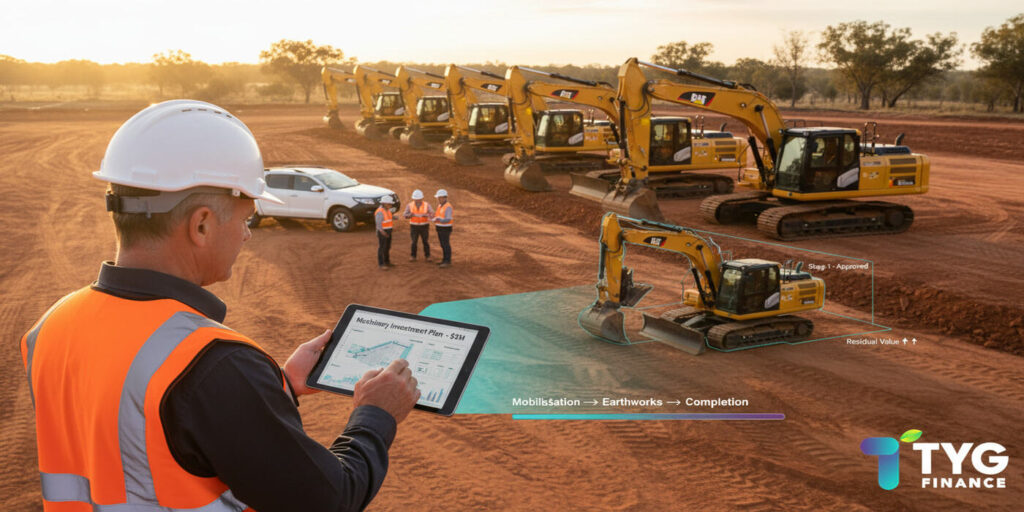
A High-Stakes Investment Challenge
Civil construction projects often hinge on having the right machinery available at the right time. For one Australian civil contractor tasked with delivering a large-scale infrastructure project, the challenge was clear: secure nearly $5 million worth of machinery to meet aggressive deadlines, all while preserving working capital for labour, materials, and contingencies.
This case study explores how the contractor weighed financing pathways, considered options for asset mix, and worked with TYG Finance to structure a solution that aligned with both operational and financial goals. For operators facing similar high‑stakes decisions at the end of the year, our guide to year‑end machinery investment decisions outlines how to weigh buy, hire, and lease against utilisation and timing.
The Problem: Securing Capacity Without Straining Capital
The contractor had won a contract to deliver a multi-stage civil works package. The scope included large-scale earthmoving, land stabilisation, and road construction – all requiring heavy machinery such as excavators and dozers.
While some equipment was already in the fleet, analysis showed significant gaps:
- Capacity limits: Existing excavators lacked the size and power to handle major cut-and-fill volumes.
- Aging dozers: Older models risked downtime at critical stages of the project.
- Tight deadlines: Delays in mobilising equipment could trigger costly penalties.
- Capital pressure: Tying up $5M in cash for machinery purchases would weaken the business’s financial position.
The leadership team recognised the need to explore financing pathways that could secure equipment quickly without undermining liquidity.
The Exploration: Weighing Machinery Financing Options
The contractor evaluated several approaches, balancing cost, flexibility, and risk.
Option 1: Purchase Outright with Cash Reserves
While this option would avoid financing costs, it came with significant downsides. Using $5M in cash would leave little room for unexpected project variations, material price increases, or working capital needs.
Option 2: Short-Term Hire of Equipment
Hiring appeared attractive for flexibility, but costs quickly escalated when scaled to a multi-year project. Availability of specialised machinery was also a concern during peak industry demand.
Option 3: Structured Financing for Key Assets
The third option focused on financing the most critical machinery, such as excavators and dozers, while maintaining cash reserves for other project expenses. Financing terms could be tailored to align with project cash flows.
Learn more about Excavator Finance and Dozer Finance for civil construction projects.
The Role of TYG Finance: Creating a Staged Financing Pathway
TYG Finance worked with the contractor to design a flexible financing arrangement. Rather than committing to all $5M upfront, the financing plan allowed:
- Staged approvals for machinery purchases as project milestones required.
- Cash-flow aligned repayments tied to contract progress payments.
- Asset-specific financing, ensuring excavators and dozers could be acquired with tailored terms.
- Pre-approval capacity, giving the contractor confidence to act quickly when suitable machinery came to market.
This structured approach enabled the contractor to balance liquidity with capacity, ensuring machinery was available without overextending financially.
Potential Solutions Considered
- Staged Fleet Expansion
- Financing high-priority machinery first (excavators for bulk earthworks).
- Adding dozers and auxiliary equipment as the project advanced.
- Mix of New and Used Assets
- Financing new machinery for critical tasks where uptime was non-negotiable.
- Supplementing with near-new used assets to optimise cost.
- Residual Value Considerations
- Selecting machinery with stronger resale value to offset long-term financing costs.
These decisions sit within a broader framework of lifecycle planning and total cost of ownership, which we explore in our key insights on fleet replacement planning.
Possible Outcomes Identified
While the project is ongoing, several outcomes were anticipated:
- Improved uptime: Newer, financed machinery reduced the risk of breakdowns at critical stages.
- Liquidity preserved: Cash reserves remained available for wages, materials, and unexpected project variations.
- Project delivery confidence: Staged financing allowed machinery to be commissioned in time for each construction phase.
- Stronger compliance posture: Modern machinery aligned with Engineers Australia guidelines and WHS standards.
- Competitive edge: With reliable machinery in place, the contractor strengthened its reputation for delivering on time.
Industry data supports this approach. The ABS Construction Data shows strong year-on-year growth in civil projects, indicating that businesses able to strategically manage machinery financing may capture more opportunities in a competitive market. For a wider view of how modern machinery choices influence both safety obligations and long‑term cost control, see our guide to balancing fleet management costs and safety. Our 2025 fleet safety and efficiency trends overview also shows how emerging technology and regulatory shifts are reshaping the business case for large machinery programs like this.
Key Learnings from the Journey
- Cash is best preserved for flexibility. Using all reserves for machinery can expose businesses to project risk.
- Hiring can be costly at scale. For multi-year projects, ownership through financing is often more efficient.
- Staged financing supports agility. Approvals structured around project milestones reduce unnecessary commitments.
- Residual value matters. Choosing assets with better resale potential may improve long-term financial outcomes.
- Finance is a strategic enabler. With the right partner, operators can grow capacity without undermining resilience.
Strategic Financing as a Growth Lever
For this civil contractor, financing $5M worth of machinery wasn’t just about meeting project requirements – it was about aligning operational needs with financial sustainability. By structuring financing with flexibility and foresight, the business positioned itself to deliver successfully while maintaining liquidity.
While every project is different, this case illustrates how TYG Finance helps operators explore pathways that balance cost, compliance, and capacity.
Begin your finance journey with TYG Finance and explore flexible solutions for your next major machinery investment.