Financing a concrete pump or a fleet of refrigerated trailers has never worked quite like financing a standard truck, and 2026 is widening that gap further. Lenders are getting more comfortable looking beyond the asset and the operator’s credit file, weighing contract revenue, connected-equipment data, and industry-specific risk factors that a generic commercial lending model simply wasn’t built to read properly. For operators in this space, that shift is opening up genuinely better terms, provided the paperwork and strategy keep pace with it.
Here’s what’s actually changing, and what it means for anyone financing specialised transport equipment right now.
At a glance
Specialised transport finance in 2026 is moving beyond asset security and credit history alone: lenders are increasingly pricing on contract revenue, connected-equipment data and industry-specific risk, which is opening up sharper rates, lower deposits and more flexible refinancing for operators with strong documentation and diversified revenue.
Contract revenue is becoming a real lever, not just a nice-to-have
Specialised equipment finance has traditionally leaned almost entirely on asset security and the operator’s credit history. That’s shifting: lenders increasingly look at contract revenue alongside the usual metrics, and operators who can present a multi-year service contract with a creditworthy client are accessing structures that simply weren’t on the table before. A car carrier operator with a solid three-year contract from a major automotive group, for instance, might secure a rate a full percentage point or more below standard specialised equipment pricing, with terms stretching to seven years rather than the usual five.
That access comes with a documentation burden, though. Contract-backed finance wants signed agreements, client credit assessments, revenue projections, and a clear picture of what happens if the contract ends early, performance guarantees, cancellation terms, fallback revenue options. Good lenders are also structuring the finance itself to match the contract: a four-year refrigerated transport contract might support four-year equipment finance with a balloon timed to land around contract renewal, giving both parties a natural point to reassess before refinancing. The one thing that still draws scrutiny regardless of how good the contract looks is concentration risk. An operator pulling 70%-plus of revenue from a single contract will get real questions about what replaces that revenue if the relationship ends, and a more diversified contract portfolio strengthens an application more than most people expect.
Connected equipment is changing how residuals get calculated
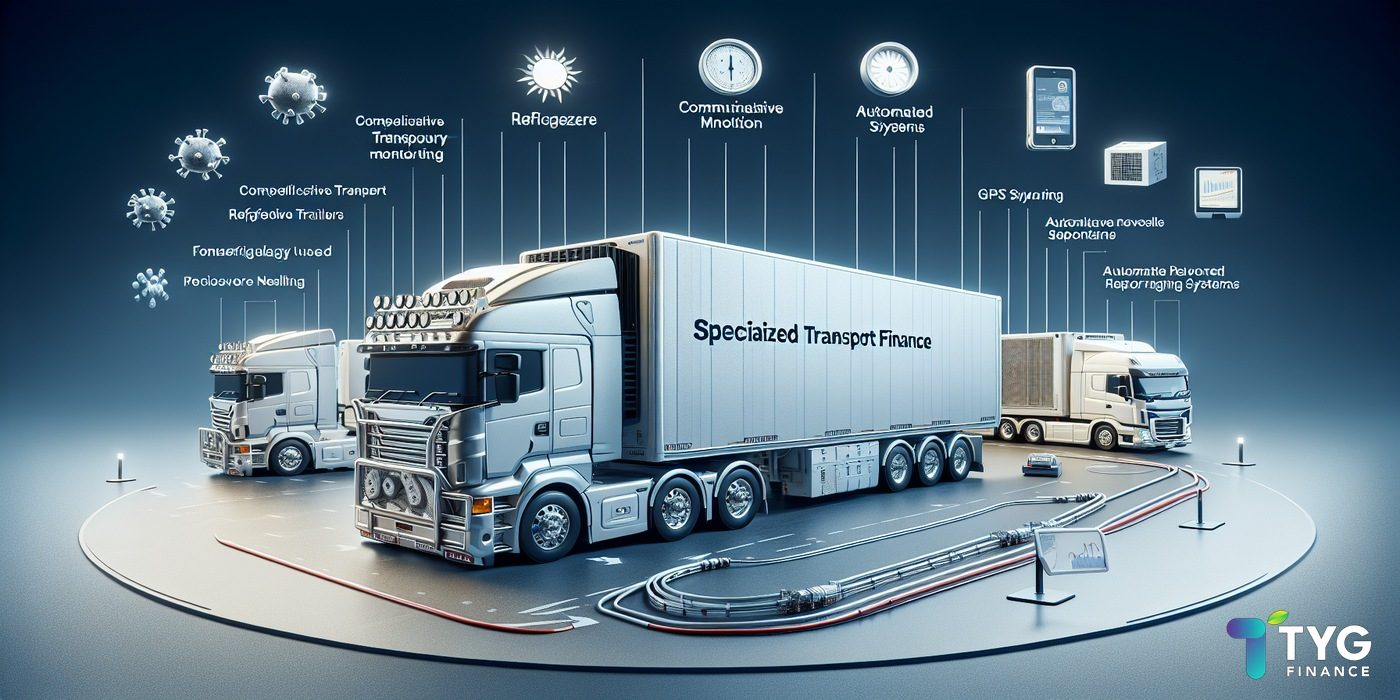
Telematics, refrigeration monitoring, GPS tracking and automated systems are now standard enough on specialised transport equipment that they’re starting to shape financing outcomes directly, in both directions.
On the upside, equipment carrying comprehensive monitoring and reporting tends to hold stronger residual values, since lenders recognise that this kind of gear appeals to quality-focused buyers and supports a healthier resale market. Verified service histories through connected systems can also unlock preferential rates, since the data genuinely reduces a lender’s uncertainty about the asset’s real condition. On the downside, rapid technology turnover cuts the other way: a telematics system that looked cutting-edge in 2023 can be visibly dated by 2026, and lenders are responding with more conservative residual assumptions on technology-heavy equipment. Some finance providers are getting ahead of this with built-in upgrade provisions, letting an operator refinance to retrofit advanced refrigeration controls or updated tracking without restructuring the whole finance package, which is a genuinely useful middle ground between locking in outdated tech and starting a new finance arrangement from scratch.
Better data is finally improving how residuals get set
Working out a fair residual value for niche equipment has always been hard given how thin the secondary market is, and that’s slowly improving. Specialised auction platforms and industry associations now provide meaningfully better transaction data, which means concrete pump residuals, historically set conservatively out of necessity, increasingly reflect what the equipment actually sells for, sometimes translating directly into higher residuals and lower monthly payments.
A few lenders are going further and experimenting with condition-based residuals, where equipment with verified maintenance records and operational data can qualify for residuals 5-10% above an otherwise identical unit without that documentation, a real reward for operators who keep proper service records. Application-specific segmentation is also emerging: a refrigerated trailer used for pharmaceutical transport tends to hold better residual value than an identical unit used for general foodstuffs, reflecting the tighter specifications and stronger resale appeal that pharma-grade equipment carries. And residual guarantees, still rare but genuinely emerging, are starting to appear from some manufacturers, BYD and a handful of European refrigeration manufacturers now offer guaranteed buyback values on certain equipment, which gives lenders more confidence to offer sharper terms.
Financing is catching up with how operators actually expand
Operators growing capacity through staged purchases rather than one bulk acquisition are finding finance products increasingly built to support that approach rather than working against it.
Some lenders now offer pre-approved facilities covering an entire staged expansion, so an operator building refrigerated capacity over 18 months can access committed funding for each defined stage without repeating the full application process every time. Cross-collateralisation across stages is becoming more common too, letting stage one equipment partially secure stage two and three purchases, which usually produces better overall terms than treating each purchase as an isolated transaction. More sophisticated arrangements also coordinate balloon payments across the stages, consolidating what would otherwise be three separate balloon dates (and three separate cash flow spikes) into a single point, simplifying refinancing considerably. And performance triggers are starting to appear in some structures, where funding for stage two or three only releases once stage one has actually hit its revenue targets, which protects both the lender and the operator from over-committing if the underlying business assumptions turn out to be optimistic.
Environmental compliance is starting to shape finance terms directly
Tightening environmental regulation is affecting specialised transport on both the equipment spec side and the finance side.
Euro 6 prime movers, hybrid refrigeration systems and electric auxiliary power increasingly qualify for green finance programs offering rate reductions of 0.3-0.8%, with government-backed schemes through the Clean Energy Finance Corporation adding further incentive on top for qualifying equipment.
0.3-0.8%
The rate reduction available through green finance programs for Euro 6 prime movers, hybrid refrigeration and electric auxiliary power, with further government-backed incentives on top.
Retrofit finance is a genuinely new development worth knowing about too: rather than replacing an entire unit, operators are increasingly retrofitting existing equipment with cleaner technology, electric standby power for refrigeration, auxiliary power units to cut main engine runtime, and specialist lenders are now willing to finance that kind of improvement, something that was previously hard to structure since retrofits don’t create the discrete collateral a standard finance product expects. Pending regulatory deadlines are also feeding into residual calculations directly, equipment approaching a compliance cliff faces accelerated depreciation, while newly-compliant equipment commands a premium, and finance structures increasingly build that timeline into terms and residuals from the outset. On top of all this, major clients are increasingly asking transport operators for emissions reporting, and equipment that supports comprehensive fuel and emissions monitoring can sometimes qualify for better finance terms simply because it lets the operator demonstrate compliance capability to their own clients.
Lenders are getting genuinely better at assessing this sector
Specialised transport finance has traditionally meant conservative risk assessment, largely because lenders lacked good data. That’s improving on a few fronts.
Progressive lenders now look at operational data alongside the standard financials, a concrete pump operator might supplement financial statements with job tracking data showing consistent utilisation, demonstrating revenue sustainability in a way historical accounts alone can’t capture. Major lenders are also building out specialised transport divisions staffed with assessors who actually understand car carrier economics or refrigerated transport dynamics, rather than routing applications through generic commercial lending officers who don’t. That expertise shows up in deposit requirements too: where 25-30% deposits used to be standard, established operators with strong maintenance records are increasingly accessing 15-20%, freeing up real cash flow for expansion.
15-20%
The deposit now available to established operators with strong maintenance records, down from the 25-30% that used to be standard for specialised transport finance.
And credit scoring is starting to account for industry-specific patterns properly, seasonal revenue swings that are entirely normal in agricultural transport no longer trigger the same red flags they would under a generic assessment, and project-based cash flow common to concrete pump operators is being evaluated on its own terms rather than against a template built for steady-revenue businesses.
Refinancing is opening up mid-term, not just at balloon maturity
Specialised equipment operators used to have genuinely limited refinancing options once an initial finance arrangement was locked in. That’s changing too.
Operators two or three years into a five-year term can increasingly refinance if circumstances shift, improved market conditions, a stronger financial position, or a new contract opportunity can all justify a rate improvement or term adjustment without waiting for the balloon date. Balloon refinancing itself has genuinely improved: rather than the old binary choice of paying out the balloon or selling the equipment, operators now have access to a competitive refinancing market with multiple lenders actively seeking quality specialised transport business. And for operators running a mixed-age specialised fleet, consolidating multiple existing finance arrangements into a single package is increasingly viable, simplifying administration and occasionally producing better overall terms through portfolio-based assessment rather than treating each piece of equipment in isolation.
Questions and Answers
How do contract-backed finance arrangements handle early contract termination?
Most contract-backed finance builds in provisions for exactly this scenario. Lenders might require minimum cash reserves, contract termination insurance, or evidence of alternative revenue capability. Some structures use stepped interest rates, preferential while the contract is active, standard if it ends, so an operator knows exactly what changes if the contracted revenue disappears. Before signing up to contract-backed finance, it’s worth being genuinely clear on what the termination provisions actually require and confirming they’re manageable rather than assuming the best case.
Is technology-enabled equipment always the better finance proposition compared to basic gear?
Not necessarily. Sophisticated technology can support stronger residuals and demonstrate operational capability, but it also adds complexity and a real obsolescence risk. Basic, well-proven equipment sometimes finances more easily than the latest tech, simply because lenders have more confidence in its long-term value. What actually matters is whether the operator can genuinely use the technology, what clients expect, and how long the equipment is likely to be held: obsolescence matters far less on a 3-4 year replacement cycle than a 7-10 year one. Technology is worth treating as an operational decision first and a financing advantage second, not the other way around.
Should specialised operators chase the lowest interest rate or the most flexible terms?
It depends heavily on circumstances and risk tolerance. The lowest rate minimises total cost but often comes with rigid terms that limit flexibility down the track. A slightly higher rate paired with flexible prepayment, refinancing provisions, or adjustable balloon timing can genuinely serve operators better in an uncertain market. Established operations with stable, predictable revenue are usually well served chasing the lowest rate. Growing businesses, or those in markets that could shift, often get more real value from flexibility provisions than from a marginal rate saving. A 0.5% rate difference on $300,000 over five years works out to roughly $7,500, meaningful, certainly, but sometimes worth less than the operational flexibility given up to get it.
Helpful Australian Resources
Clean Energy Finance Corporation
Information about green financing programs for transport equipment and environmental compliance.
Website: www.cefc.com.au
Australian Trucking Association (ATA)
Industry insights, regulatory updates, and specialized transport sector information.
Website: www.truck.net.au
National Heavy Vehicle Regulator (NHVR)
Compliance requirements affecting specialized transport equipment and operations.
Website: www.nhvr.gov.au
Australian Taxation Office (ATO)
Tax treatment of specialized equipment finance and depreciation schedules.
Website: www.ato.gov.au
What this means in practice
These shifts create real opportunity for operators who come prepared, but they do reward a more sophisticated approach to financing than simply shopping the headline rate. Comprehensive documentation matters more than ever: detailed financials, operational data, service histories and contract paperwork all directly affect what’s on offer, given how much contract-backed and performance-based assessment now leans on this information. It’s worth evaluating the total cost of an arrangement rather than the interest rate in isolation too, since residual values, term flexibility and refinancing provisions can easily outweigh a modest rate advantage once the full structure is compared properly.
Technology decisions are best made for operational reasons first, with financing benefits treated as a secondary consideration, sophisticated systems that don’t actually suit how the operator works create cost without delivering much value either way. And it’s worth keeping an eye on upcoming regulatory changes when timing an acquisition, since compliance deadlines are increasingly built directly into how equipment gets valued and financed.
TYG Finance works with Australian specialized transport operators navigating evolving equipment financing markets. We understand that concrete pump finance, truck finance, trailer finance, and other specialized equipment financing requires industry knowledge and lender relationships.
Ready to discuss specialized transport financing? Contact TYG Finance to explore how current market trends might create opportunities for your equipment acquisition plans.
Contact TYG Finance today to discuss specialized transport equipment finance options.
Important Disclaimer
This trend article is provided for general information only and should not be considered financial advice. Finance market conditions, lender policies, and regulatory requirements change frequently. Information presented reflects market observations as of March 2026 and may not represent future conditions or typical outcomes.
Finance applications are subject to individual assessment. Interest rates, fees, terms, and conditions vary based on circumstances, lender criteria, and market conditions at the time of application.
Before making equipment finance decisions, consult with qualified accountants and seek independent financial advice about your specific circumstances.
TYG Finance is a commercial finance broker. We may receive commissions from lenders for successful finance arrangements.
About TYG Finance
TYG Finance is an Australian commercial finance broker specializing in vehicle and equipment finance solutions for transport operators.
Disclaimer: This article is provided for general information only.
Related Articles
- Financing Specialised Transport for Cash Flow Control – Read our specialized transport financing guide
- Refrigerated Transport Finance Trends for 2026 – Explore refrigerated transport trends
- Construction Equipment Finance Trends for 2026 – Compare with construction equipment trends