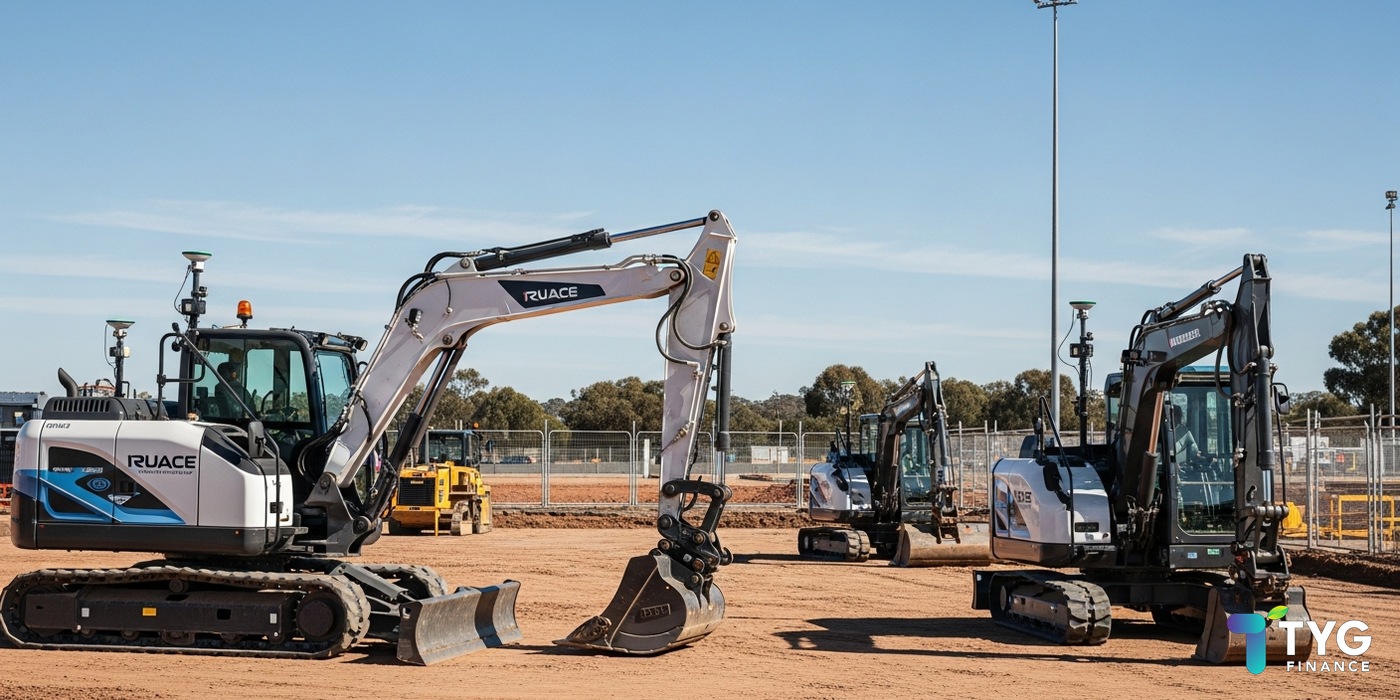
Diesel still runs the vast majority of Australian earthmoving fleets, and that’s not about to flip overnight. But 2026 is shaping up as the year several parallel shifts, electrification, automation, GPS accessibility, standard telematics, tightening emissions rules, stop being future-tense conversations and start showing up in actual procurement decisions. None of them individually force a fleet rethink. Together, they’re changing what a sensible equipment and finance strategy looks like for civil contractors.
This article works through what’s actually changed, what’s still more promise than product, and where the finance side of the equation is adapting.
At a glance
Diesel still runs most Australian earthmoving fleets, but electrification, automation, GPS and telematics have all moved from future-tense conversations into real procurement decisions in 2026. The most useful finance takeaway is that lenders are increasingly assessing total cost of ownership rather than sticker price alone, so contractors weighing higher-cost technology like electric excavators or GPS machine control should factor in operating cost savings, residual value uncertainty, and matching finance terms to the technology’s realistic lifecycle rather than the equipment’s full working life.
Electric equipment: real, but narrower than the marketing suggests
Electric earthmoving equipment has genuinely moved from demonstration units to commercially available machines for specific applications. Caterpillar, Komatsu, Volvo and Hitachi now offer electric excavators from 5 to 26 tonnes, and electric wheel loaders are available from Volvo, Komatsu and LiuGong in the 3-18 tonne range. Dozers lag behind, Komatsu’s 17-tonne electric unit is about as large as it gets for now, with bigger machines still expected later in the year. Compact equipment, skid steers, mini-excavators, small loaders, is where electric adoption is furthest along, simply because battery weight and range constraints matter less at that scale.
A 20-tonne electric excavator today typically runs 6-8 hours under moderate load from a 350-400kWh battery pack, fast-charges to 80% in 60-90 minutes given adequate charging infrastructure (150kW+), or takes 8-10 hours overnight on standard industrial power. Dig force and hydraulic performance are broadly comparable to diesel equivalents, though payload runs 900-1,000kg lower, the battery weight has to come from somewhere.
The economics are more favourable than the sticker price suggests. A 20-tonne electric excavator runs roughly $385,000 against $280,000 for a comparable diesel unit, a $105,000 premium. But annual fuel and electricity costs at 2,000 hours favour electric heavily, roughly $11,000 against $38,000 for diesel, and maintenance is cheaper too, around $6,200 against $14,500. Over five years, total operating cost savings of around $154,500 more than offset the higher purchase price, delivering roughly a 9% total cost advantage over the equivalent diesel machine, and that gap widens for contractors running 2,500+ hours a year. Residual value assumptions remain genuinely uncertain given the limited operating history, so a conservative 30% estimate is the sensible planning basis rather than the manufacturer’s optimistic case.
9%
Total cost advantage a 20-tonne electric excavator delivers over five years compared to a diesel equivalent, once $154,500 in fuel and maintenance savings are counted against the $105,000 purchase premium.
The economics don’t remove the practical constraints, though. Most Australian construction sites simply don’t have 150kW+ charging capacity, which means depot charging or generator-based site charging, adding $15,000-$35,000 in infrastructure cost most operators haven’t budgeted for. Contractors working regional sites without reliable power access will find electric equipment genuinely impractical for now, this is an urban and suburban civil work technology at this stage, not a regional one. Battery degradation, roughly 10-15% capacity loss across 5,000-6,000 hours, and eventual replacement costs of $60,000-$90,000 need to sit in any lifecycle planning honestly rather than being ignored. And because residual values are still speculative, lenders typically finance electric equipment at 70-75% LVR against 80-85% for diesel, with longer terms (6-7 years) sometimes used to amortise the higher purchase price, constrained by how long the battery is actually expected to last. Some lenders are beginning to offer finance structured around total cost of ownership rather than sticker price, which recognises the operating cost savings directly, and government incentives or accelerated depreciation can improve the economics further depending on individual circumstances.
Automation is changing what “experienced operator” means
Automation features are increasingly standard on new excavators: automatic bucket filling that optimises dig depth and angle, grade limit control that prevents over-excavation, swing priority automation, and automated truck loading sequences that reduce spillage through consistency. None of this replaces the operator, but it does mean a moderately experienced operator can now achieve productivity that used to require a genuine veteran.
Autonomous compaction has moved further than most people realise, several roller manufacturers now offer systems where operators simply program coverage patterns and the machine executes independently. Early Australian adopters commonly report 20-30% productivity improvements alongside more consistent compaction outcomes. GPS-guided dozer automation delivers similar gains on bulk earthworks: autonomous grade following, optimised blade load management, and consistent material spreading that reduces operator fatigue on genuinely repetitive work. Reports of 25-30% faster bulk earthworks completion with meaningfully lower fuel use through optimised blade management aren’t unusual with semi-automated GPS dozers.
This matters for a reason beyond raw productivity: the skilled operator shortage. Automation that partially handles complex tasks lets contractors get real productivity from operators with 2-3 years of experience that would previously have required 8-10. Given experienced excavator operators command $42-$48 an hour against $32-$38 for moderately experienced ones, automation can effectively reduce labour cost by $80-$120 a day while holding productivity steady. Automation packages add $35,000-$65,000 to purchase price depending on sophistication, and for contractors running equipment 1,500+ hours annually, that premium typically pays back within 18-30 months through the combined productivity and labour cost advantage.
GPS has gone from specialist tool to accessible standard
Machine control GPS has matured well past the point of being complex, expert-only technology. Current systems deliver sub-20mm vertical accuracy under ideal conditions (20-30mm is typical working accuracy), real-time design updates over cellular or radio, multi-constellation satellite coverage (GPS, GLONASS, Galileo, BeiDou) for better reliability, cloud-based project management tying together surveys, designs and as-built verification, automated bucket calibration, and slope-work terrain compensation.
Pricing has come down enough to matter for smaller contractors: entry-level 2D grade control now starts around $18,000-$22,000, down from $35,000-plus just three years ago, and mid-range 3D systems with full functionality run $28,000-$38,000, still a real investment but one that delivers measurable returns through productivity gains and reduced rework. Integration with project management systems adds real-time productivity tracking (cubic metres an hour, cost per cubic metre), as-built verification against design, automated progress reporting, and material quantity reconciliation, turning GPS from a machine-level tool into something that supports evidence-based decisions across the whole business. For project-specific needs, several providers now offer GPS equipment on subscription, a six-month project needing GPS can access it for $3,200-$4,200 a month rather than a $35,000 purchase, which meaningfully lowers the barrier to trying the technology.
Telematics: from premium feature to expected standard
Comprehensive telematics, once reserved for premium equipment, is now close to standard across most brands. Modern machines commonly include real-time GPS/cellular location tracking, operating hours and idle time monitoring, fuel consumption analysis, usage-based maintenance alerts, diagnostic fault code reporting, geofencing with unauthorised-use alerts, and operator identification with performance metrics.
The predictive maintenance angle is where this pays off most directly. Systems monitoring oil pressure, temperature and contamination, tracking hydraulic performance degradation, and flagging component wear ahead of replacement intervals can predict failures 80-120 hours before they happen. Contractors implementing comprehensive telematics monitoring commonly report unplanned downtime cut by 50-65%, catching developing issues during a scheduled break rather than facing a failure mid-job.
50-65%
Reduction in unplanned downtime reported by contractors running comprehensive telematics monitoring, which can predict failures 80-120 hours in advance.
The utilisation data on top of that, actual productive hours against idle time, deployment efficiency across jobs, operator-level fuel and productivity variation, and better-informed replacement timing, turns equipment management decisions from estimate-based to evidence-based.
There’s a financial upside too: several Australian commercial insurers now offer 8-12% premium discounts for equipment running active telematics, since real-time monitoring reduces theft risk, speeds recovery of stolen equipment, and supports safer operating practices generally. The resulting saving, commonly $400-$800 a year per machine, substantially offsets telematics subscription costs, which typically run $480-$960 annually.
Emissions standards are reshaping resale value, not just compliance
Equipment sold in Australia increasingly meets Tier 4 Final or Stage V emissions standards, requiring diesel particulate filters cutting particulate emissions by 90%-plus, selective catalytic reduction systems minimising nitrogen oxide, and more sophisticated engine management for combustion efficiency. That compliance adds $12,000-$22,000 to equipment cost and brings genuine operational overhead: DEF/AdBlue refilling every 300-500 hours, occasional active DPF regeneration cycles, more complex maintenance, and real sensitivity to fuel quality. The upside is that modern emissions-compliant equipment typically runs 12-18% more fuel efficient than older models, which goes some way to offsetting the added complexity and DEF cost.
The bigger story is what this means for older equipment. Several Australian councils and major contractors now specify Tier 4/Stage V equipment for urban sites on air quality grounds, which means equipment that doesn’t meet current standards is starting to face exclusion from a growing category of work, with knock-on effects for resale value and utilisation. Emissions-compliant equipment already commands stronger residuals and better finance terms than older-spec machines, and that gap looks set to widen. Contractors financing equipment now should weight current emissions compliance heavily, both for market access today and residual value protection down the track.
Hybrid, hydrogen and biodiesel: the middle ground
Full electrification isn’t the only path to lower emissions. Hybrid excavators and loaders, running a diesel engine at optimal efficiency to charge batteries that handle variable power demand, with regenerative systems capturing swing and boom energy, typically cut fuel consumption 20-30% against conventional diesel. The technology adds roughly $60,000-$85,000 to purchase price, and for equipment running 2,000-plus hours annually, that premium is usually recovered in fuel savings within three to four years.
Hydrogen fuel cell prototypes exist from several manufacturers, but commercial availability remains limited in 2026. It’s a technology worth watching for large equipment, 40-tonne-plus excavators, big dozers, where battery-electric solutions genuinely struggle with weight and range. Australian deployment is waiting on hydrogen refuelling infrastructure that currently exists only in specific industrial precincts and mining operations. Biodiesel and renewable diesel are more immediately accessible: most modern equipment supports B20-B30 blends and renewable diesel without modification, cutting lifecycle emissions 40-60%, though availability outside major centres is limited and an 8-15% price premium keeps adoption modest. It’s worth exploring for contractors facing client sustainability requirements, but it’s not yet a mainstream option.
Finance is starting to catch up with the technology shift
Equipment finance is adapting to higher purchase prices, new residual value dynamics, and technology that changes mid-lifecycle. A growing number of lenders now structure finance around total cost of ownership rather than purchase price alone, recognising electric equipment’s operating cost savings in serviceability assessments, sometimes reflecting that in lower interest rates, extending terms to 6-7 years to match technology lifecycle, and building in flexibility for battery replacement. Some arrangements now include technology upgrade provisions, letting a contractor upgrade GPS, automation or telematics mid-term without refinancing the whole equipment package. Performance-linked finance, where payments vary with utilisation or productivity metrics, remains uncommon in 2026 but is a plausible next step as telematics data makes objective performance measurement straightforward.
Questions and Answers
Should Australian contractors prioritise electric earthmoving equipment in 2026?
It makes sense for specific applications: urban and suburban civil work with depot or reliable site charging, operations running 1,800-2,000-plus hours annually where fuel savings are maximised, and contractors where environmental credentials genuinely matter for tender competitiveness. Total cost of ownership over five years often favours electric despite the higher purchase price. But contractors working regionally without charging infrastructure, running seasonally at lower annual hours, or needing maximum payload should assess carefully whether current electric technology actually suits them, rather than following the trend. Hybrid equipment can offer a pragmatic middle path, better efficiency and lower emissions without the range constraints. Most contractors are probably better served monitoring electric equipment development while running predominantly diesel fleets through 2026, transitioning as technology, infrastructure and financing all mature further.
How do automation and GPS affect resale value?
Technology-equipped equipment commands noticeably stronger residuals than basic configurations, GPS-equipped excavators typically achieve 8-12% higher resale than equivalent models without it, and automation adds a similar premium. The catch is that the technology has to be current: GPS systems from 2020-2021 provide limited resale benefit now, since buyers are prioritising the latest capability. That creates a real tension for contractors, technology investment improves both operational returns and residual value, but only if replacement timing keeps pace with how fast the technology moves. Trading equipment around 5,000-6,000 hours tends to capture technology value well; running past 8,000 hours often means the fitted technology has become dated, reducing the premium it would otherwise command.
Will emissions regulations affect finance availability for older equipment?
Quite possibly. Some Australian lenders are starting to factor emissions compliance into equipment finance assessments, treating non-compliant equipment as having constrained market access and declining residual value. That doesn’t currently prevent financing older equipment outright, but it can mean higher interest rates, lower LVR limits, or shorter maximum terms. And as urban sites increasingly specify Tier 4/Stage V equipment, older machines face growing utilisation constraints that directly affect revenue and loan serviceability. Contractors financing equipment now should prioritise current emissions compliance to protect both finance terms and residual value, and those already running older equipment should factor in that it may face increasing market constraints, particularly relevant for anyone relying on refinancing at the end of a balloon structure.
Helpful Australian Resources
Civil Contractors Federation (CCF)
Industry insights on technology adoption, equipment trends, and operational best practices for civil contractors.
Website: www.civilcontractors.com
Clean Energy Regulator
Information on emissions standards, equipment incentives, and environmental compliance for construction equipment.
Website: www.cleanenergyregulator.gov.au
Australian Taxation Office (ATO)
Tax treatment of equipment depreciation, technology investment, and instant asset write-off provisions that may apply to qualifying equipment.
Website: www.ato.gov.au
Safe Work Australia
Safety standards for earthmoving equipment operation, automation technology, and workplace compliance.
Website: www.safeworkaustralia.gov.au
Navigating the transition without overcommitting either way
None of these shifts demand a wholesale fleet replacement, and none of them are worth ignoring either. A measured approach tends to work best: piloting one electric or heavily automated machine in a genuinely suitable application before committing further, tiering technology toward the highest-utilisation equipment where GPS and automation deliver the fastest return, building charging infrastructure progressively rather than waiting for a fleet-wide switch, structuring finance around realistic technology lifecycle (shorter terms for technology-heavy equipment, longer for conventional machines), and prioritising current emissions compliance and proven technology over the newest features with uncertain resale value.
Contractors who assess new technology against actual business requirements, calculate a realistic total cost of ownership, and structure finance to match tend to navigate this transition well, avoiding both premature adoption of immature technology and being left behind by equipment that’s simply aged out of relevance.
TYG Finance works with Australian earthmoving contractors exploring equipment finance for conventional, electric, and technology-equipped earthmoving equipment. We understand that excavator finance, loader finance, and dozer finance in 2026 involves balancing technology benefits, cost implications, and operational requirements.
Ready to discuss earthmoving equipment finance? Contact TYG Finance to explore finance structures that might support your equipment technology decisions and business objectives.
Contact TYG Finance today to discuss financing for earthmoving equipment across conventional and emerging technology options.
Important Disclaimer
This trend article is provided for general informational purposes only and should not be considered financial, technical, or professional advice. The information presented reflects market observations and technology trends as of early 2026. Equipment technology evolves rapidly, and capabilities, costs, and availability may change.
Electric equipment total cost of ownership calculations depend on numerous assumptions including utilization rates, electricity costs, maintenance expenses, and residual values. Actual outcomes vary based on specific circumstances, operational practices, and market conditions.
Equipment finance applications are subject to individual assessment. Interest rates, fees, terms, and conditions vary based on circumstances, lender criteria, and market conditions. Government incentives and tax treatments depend on specific regulations and individual circumstances, consult qualified tax professionals for advice relevant to your situation.
Before making equipment purchase or finance decisions, you should:
- Verify current equipment specifications and capabilities with manufacturers
- Conduct comprehensive total cost of ownership analysis for your specific usage patterns
- Consult with qualified accountants regarding tax implications and depreciation treatment
- Seek independent financial advice about your circumstances
- Assess infrastructure requirements for electric or advanced technology equipment
- Review all finance documentation carefully before committing
- Consider operational requirements, utilization expectations, and replacement planning
Technology adoption should align with documented business requirements rather than following trends or marketing claims. Carefully assess whether specific technologies deliver measurable benefits justifying their costs in your operational circumstances.
TYG Finance is a commercial finance broker. We may receive commissions from lenders for successful finance arrangements. This article does not constitute a recommendation to purchase any specific equipment type, technology, or brand.
All applications subject to lender approval. Information current as of publication date and may change as technology, regulations, and market conditions evolve.
About TYG Finance
TYG Finance is an Australian commercial finance broker specializing in equipment finance solutions for civil contractors and earthmoving operators. We work with lenders to help contractors explore finance options for conventional and emerging technology earthmoving equipment that may suit their operational requirements.
Disclaimer: This article is provided for general information only. TYG Finance recommends seeking independent financial advice before making finance decisions.
Related Articles
- Earthmoving Equipment ROI and Job Matching Guide – Review our equipment ROI guide
- Earthmoving Equipment Selection: Key Factors to Consider – Learn about selection factors
- Construction Equipment Finance Trends for 2026 – Compare with related industry trends